

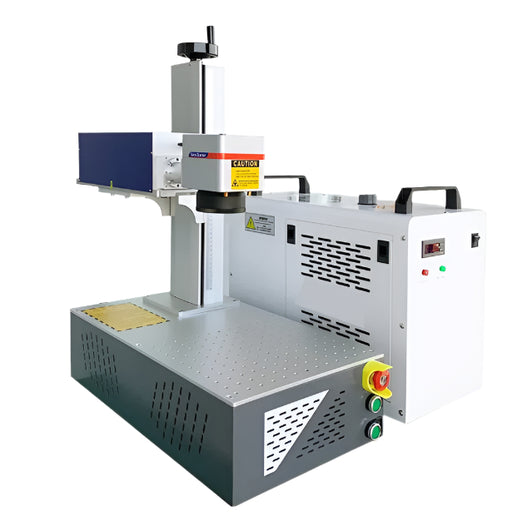
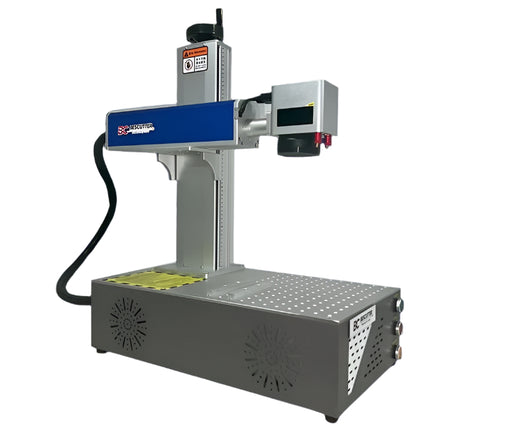
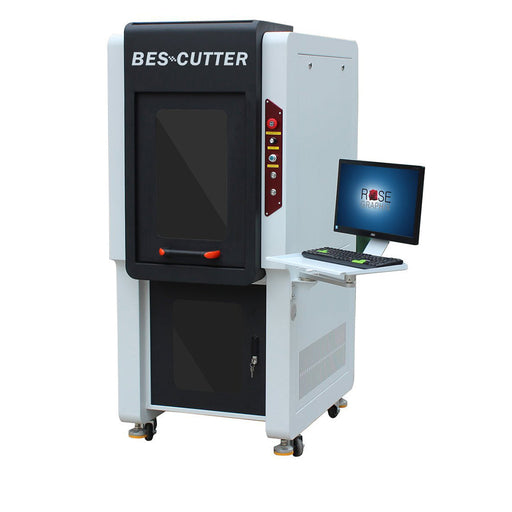
In the industrial marking and precision jewelry sectors, the Fiber Laser Engraving Machine is unrivaled. This solid-state technology is the top choice for working with metals, hard plastics, and specialized materials, offering a level of detail, speed, and durability that sets it apart from CO2 equipment. If you're looking for the best machine to engrave stainless steel or want to understand the difference between a MOPA and a Q-switched fiber laser , this guide will provide you with the essential knowledge to invest wisely.
How does a fiber laser machine work? The phenomenon of amplification
Unlike CO2 lasers that use a gas tube, fiber lasers generate the beam inside an optical cable. This process is known as fiber core amplification .
The generation of the 1.064 nm beam
The heart of the machine is the Fiber Laser Source (e.g., MAX Photonics, Raycus, or IPG). Inside this source, pump diodes inject light at specific wavelengths into a fiber optic cable doped with rare-earth elements (such as ytterbium). The light is amplified as it travels through the fiber until it reaches a wavelength of 1064 nm (in the near-infrared). This wavelength is exceptionally well absorbed by metals, enabling high-energy, high-contrast engraving.
The Galvo system: speed over motion
Fiber optic technology almost universally uses the Galvo (Galvanometric) system . Instead of moving the print head along the X and Y axes (as on a flatbed table), the beam is reflected by two extremely fast scanning mirrors (galvanometers). This mechanism allows marking speeds of up to 10,000 mm/s, which is key to the high productivity of these machines.
Essential components: Power supply, optics, and internal chiller
The durability and performance of a fiber laser depend directly on the quality of its key components, which are designed to operate for more than 100,000 hours.
Optical system: the F-theta lens and focusing
The optical system of a fiber laser is simpler and more robust than that of a CO2 laser. The beam is directed through a collimator and then strikes the F-theta lens . This special lens is crucial because it ensures that the laser beam, even when directed by Galvo mirrors, maintains precise and uniform focus across the entire engraving area (e.g., 110 mm x 110 mm or 300 mm x 300 mm), minimizing edge distortion.
Air cooling: high efficiency and low maintenance
Unlike high-power CO2 lasers, fiber lasers up to 50W utilize built-in air-cooling systems. This is due to their extremely high energy efficiency; most of the energy consumed is converted into laser light, and the small amount of residual heat can be dissipated by fans, drastically reducing maintenance requirements.
Types of fiber laser sources: Q-Switched vs. MOPA
The choice of source defines the machine's capabilities, especially in coloring and plastics applications.
- Q-Switched (Q-Switching Mode): This is the most common and economical type. It produces high-energy pulses with a relatively long duration (nanoseconds) at fixed frequencies. It is excellent for deep etching and for marking metals and plastics in black/white. However, its ability to control coloration on stainless steel is limited.
- MOPA (Master Oscillator Power Amplifier): The most advanced power supply. It allows independent variation of pulse duration (from 2 ns to 500 ns) and frequency. This flexibility is crucial.
Specific advantages of MOPA technology
The MOPA not only allows for color etching on stainless steel and titanium by oxidizing the surface in a controlled manner with different pulses, but also offers a better finish on plastics (preventing the formation of bubbles and carbonization) and minimizes heat damage on thin metals (such as aluminum sheets).
Power and Depth: A Guide to Choosing
The power in a fiber laser translates into speed for surface marking and depth for industrial engraving.
Power selection according to application
The most common power for fiber optic recorders ranges between 20W and 100W:
- 20W - 30W: Ideal for most surface marking jobs, product identification, QR codes, and light jewelry engraving. It's the most cost-effective option.
- 50W: The industry standard. It offers a perfect balance between marking speed and the ability to engrave deeply (up to ±0.3 to 1 mm on soft metals, such as aluminum) and cut very thin metal sheets.
- 100W or higher: Primarily used for deep engraving and high-speed cutting of thin metals, often on automated production lines.
Top materials: What can a fiber laser engrave?
Fiber lasers are highly reflective to non-metals, but incredibly efficient with metals. Their specialty is hard surfaces.
The list of compatible materials
The 1.064 nm laser is successfully absorbed by:
- Metals: Stainless steel, carbon steel, aluminum (anodized or bare), brass, copper, gold, silver, and titanium. The marking is permanent and abrasion-resistant.
- Plastics: ABS, polyethylene, nylon, polycarbonate, and various polymers. Fiber lasers produce high contrast on these materials without the need for additives.
- Coated materials: Metal paint, anodized finishes, and plating. The fiberglass removes the top layer to expose the base material.
Key limitations
Fiber lasers are unsuitable for most organic materials. Wood, thick acrylic, leather, and paper do not absorb this wavelength well; at best, they leave a very shallow, low-contrast mark. For these materials, a CO2 laser is mandatory.
Software and control: the EzCad standard
The software defines the ease of use and the precision of the engraving, and the industry standard in fiber is the Galvo controller.
EzCad: The engine of Galvo machines
The EzCad controller is the most common and compatible software for Chinese fiber sources (Raycus, MAX). While its interface may be less intuitive than other programs, it allows granular control of specific fiber parameters: pulse frequency, pulse duration (in MOPA), and scan direction. A thorough understanding of EzCad is essential to fully utilize the machine's potential.
LightBurn Compatibility (For Engraving)
Some newer fiber machines, or manufacturers seeking an improved user experience, are integrating LightBurn compatibility. This software is known for its ease of use, but it's crucial to verify that the machine's controller (the Galvo control board) is LightBurn compatible, as not all are out of the box.
Competitive advantages and return on investment (ROI)
The high speed and zero need for consumables make the fiber laser a cost-effective investment for mass production.
Permanent marking and traceability
Fiber laser engraving produces a very high-resolution mark that is permanent. This is essential for industries that require traceability, such as the medical, aerospace, and automotive sectors, where parts must bear 2D barcodes, serial numbers, or permanent logos.
Low operating cost
With a laser module lifespan exceeding 100,000 hours and the exclusive use of air cooling (in models up to 50W), the operating cost of fiber lasers is extremely low. There is no need to replace expensive gas tubes, mirrors prone to misalignment, or maintain constant industrial chillers.
Maintenance and safety
Maintenance is minimal, but optical safety is critical due to the invisible nature of the beam.
F-theta lens care
The only critical maintenance point is the F-theta lens . It must be kept free of dust and etching residue. Unlike CO2 optics, cleaning is done with specific optical solutions and cloths, as any scratches on the surface can scatter the beam and ruin the focus.
Safety: the risk class and protective eyewear
A fiber laser is typically Class 4 equipment because the 1064 nm beam is invisible and can cause instant and irreversible eye damage, even through diffuse reflections. The use of certified safety glasses and enclosed protective enclosures is a mandatory safety measure.
Tips for strategic buying
Before purchasing fiber optic equipment, make sure the main component meets the necessary quality and support requirements.
- Check the power supply: Make sure the power supply brand (Raycus, JPT, or IPG) is genuine and comes with a warranty. This is more important than the brand of the machine's assembler.
- Consider MOPA for versatility: If you plan to work with plastics, thin sheets, or color engraving on metals, the extra investment in MOPA technology will quickly pay for itself.
- Software Support: Confirm that the provider offers advanced training on EzCad , including the adjustment of parameters such as *Hatch* (fill) and *Loops* (passes), which are vital to the quality of the engraving.
The Fiber Laser Engraving Machine is the ultimate tool for digital manufacturing that demands permanence, detail and speed on metal and engineering plastic materials.