

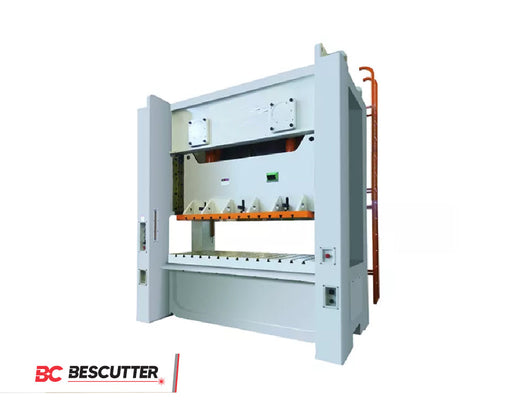


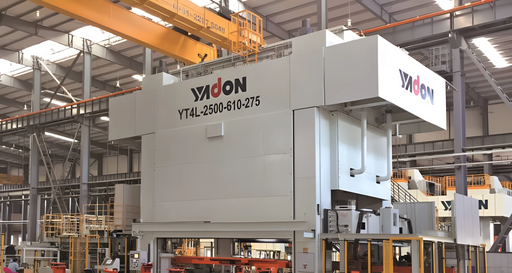
A stamping press is an industrial machine designed to cut, punch, bend, or form materials by applying mechanical force through a die. It is widely used in the metalworking, automotive, appliance, and mass production industries for the efficient processing of sheet metal.
How the die-cutting press works
The operation of a die-cutting press is based on the principle of die-cutting, which involves the use of specialized tools (punch and die) to shape the material. This process is carried out by applying significant force , usually generated by mechanical inertia systems or advanced servomotors. These mechanisms allow for the precise and repetitive application of pressure, resulting in fast and consistent production cycles.
The presses are equipped with custom-made dies that are fixed to the table and ram. The precision of this machinery lies in the rigidity of its structure and guides, allowing for cuts with minimal tolerances , essential for high-quality parts.
Operating cycles generally involve the following steps:
- Feeding the material (manual or automatic) into the work area.
- Activation of the clutch or servo system to start the descent.
- Impact force exercise to perform the cut or shape at the bottom dead center.
- Return of the ram to its initial position, ready for the next cycle.
Thanks to these processes, high efficiency is achieved. The ability to adapt the speed (strokes per minute) and stroke according to the task is crucial for optimizing production time.
Types of die-cutting presses and their characteristics
In the industrial sector, presses are categorized by their drive technology. At Bestutter, we offer solutions for every need:
- Mechanical presses: These are the standard for mass production. They use a flywheel and a connecting rod-crank system to transform rotary motion into linear motion. They are ideal for high-speed and blanking tasks where power is a priority.
- Servo Presses: The technological evolution. Equipped with high-torque servomotors that eliminate the handwheel, they allow 100% control of speed and position throughout the entire stroke. They are perfect for complex forming, deep drawing, and energy savings.
- Hydraulic presses: These operate using oil pressure. They are notable for maintaining constant maximum force throughout the stroke, although they are usually slower than mechanical presses.
- High-speed presses: Mechanical variants designed with dynamic balancing to operate at hundreds of strokes per minute, typically used in the electronics industry for terminals and connectors.
- OBI type presses (Open Backed Inclinable): Their design with an unclassifiable "C" frame facilitates the removal of parts by gravity and access to the work area.
Choosing between a mechanical or a servo motor depends on the production volume, the complexity of the part, and the material to be worked.
Key parts and components
To ensure efficient operation, the press is made up of robust components:
- Frame: Rigid structure (type "C" or Straight Side) that supports all the force without deforming.
- Flywheel: (In mechanical presses) Stores the kinetic energy of the engine to release it on impact.
- Crankshaft / Eccentric: Main shaft that converts rotation into vertical movement of the ram.
- Ram (Slide): Moving part that carries the punch and descends onto the material.
- Table (Bolster): Rectified surface where the lower die is fixed.
- Clutch/Brake System: Synchronizes movement and stops the machine for safety.
- Overload Protection (HOLP): Hydraulic system that releases pressure if the maximum tonnage is exceeded, protecting the machine.
- Control panel (PLC/HMI): Interface for configuring counters, cams and monitoring equipment status.
Industrial applications
Die-cutting presses are the backbone of multiple sectors:
- Automotive: Stamping of body panels, chassis, brackets and metal clips.
- White Goods Line: Manufacturing of appliance casings, front panels and internal components.
- Electronics: Production of tiny connectors, heat sinks and precision housings.
- Construction and Hardware: Mass manufacturing of hinges, brackets and fittings.
- Packaging and Containers: Cutting of metal lids and aluminum containers.
Competitive advantages of die-cutting
Implementing modern presses in your production line offers tangible benefits:
- Efficiency and Volume: They are unmatched in production speed compared to laser cutting or other methods for repetitive parts.
- Precision and Repeatability: They guarantee that part #1 is identical to part #1,000,000, ensuring quality.
- Versatility: A single machine can perform cutting, bending, embossing and coining simply by changing the die.
- Cost per Piece: Although the initial investment is considerable, the unit cost in mass production is extremely low.
Maintenance to maximize useful life
Preventive maintenance is vital to protecting your investment. A solid program should include:
- Automatic Lubrication: Check daily the oil levels and the operation of the centralized lubrication pump.
- Clutch Inspection: Check the wear of the brake and clutch pads to ensure safe stopping times.
- Leveling and Parallelism: Periodically check that the ram descends parallel to the table to avoid damaging the dies.
- Safety Inspection: Test light curtains and emergency stop buttons before each shift.
Purchase considerations
To choose the right press, consider:
- Tonnage required: Calculate the force needed to cut your thickest and hardest material.
- Table size: Make sure your current and future dies fit in the work area (Bolster Area).
- Speed (SPM): Defines how many pieces per minute you need to produce to meet your goals.
- Frame type: Choose "Straight Side" for maximum precision and progressive dies, or "C Frame" for general work and lower cost.
At Bestutter , we offer expert advice to help you set up the ideal printing line for your business.