


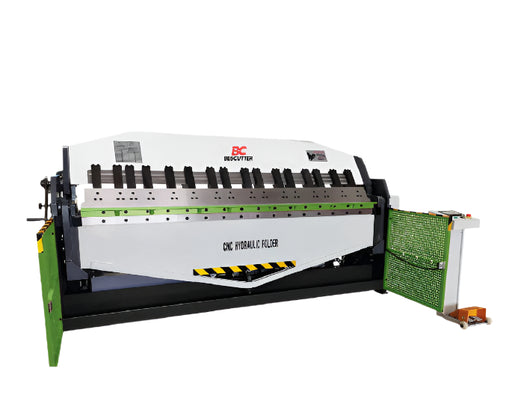
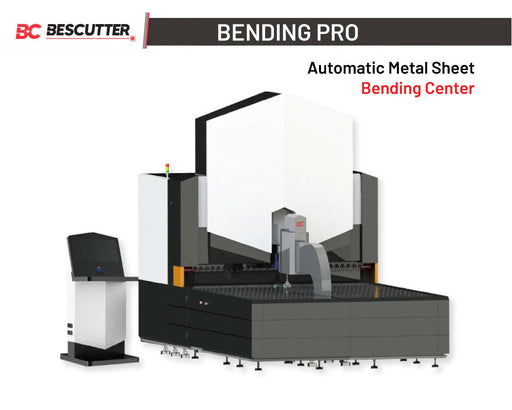
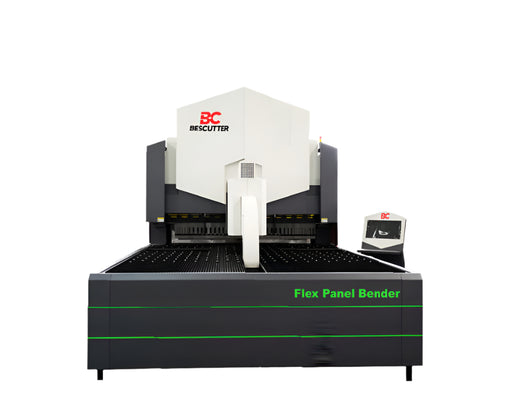
CNC press brakes are the heart of sheet metal processing. They enable the production of precise and repeatable bends essential for sectors such as metalworking, automotive, appliances, and aerospace. At Bescutter, we offer a complete range of solutions: from the hydraulic power of traditional press brakes to the servo-electric speed of automatic panel bending centers.
How does a CNC folding machine work?
The process is based on the plastic deformation of the metal using controlled force. Depending on the technology, this is achieved in two main ways:
- Press Brakes: A punch goes down onto a die to force the angle.
- Panel Benders: Oscillating blades automatically bend the sheet up and down.
Modern CNC systems calculate the depth of the blow, the sequence of bends, the compensation of deformation (crowning) and the elastic return (springback), ensuring perfect angles from the first piece.
Types of folding machines we offer
Select the appropriate technology based on your volume and type of part:
-
Hydraulic Press Brakes (K and Advance Series): (See Models)
The most versatile solution for the industry. Ideal for workshops requiring strength (tonnage) and flexibility to bend everything from thin sheet metal to thick structural plate. They offer excellent rigidity and advanced CNC control. -
Automatic Bending Centers (Panel Benders): (See Models)
15-axis systems designed for high-speed production of boxes, panels, and cabinets. They eliminate tool changes and handle the workpiece automatically. Perfect for continuous 24/7 production with minimal human intervention. - Tandem High Tonnage: Two or more synchronized press brakes for bending extremely long parts (light poles, transport structures).
- Wire Bending Machines: Specialized equipment for 3D CNC wire bending, used in the manufacture of furniture, hooks and automotive components.
Main components of a quality folding machine
The precision of our Bestutter equipment lies in its components:
- Monoblock Frame: Annealed steel structures that guarantee rigidity and stability.
- Measuring Systems (Linear Scales): Optical rules that measure the position of the ram with micron precision (0.001mm).
- Backgauge: Motorized systems with up to 6 axes (X, R, Z1, Z2) to accurately position the blade.
- Automatic Crowning: Arrow compensation system on the lower table to ensure that the angle is equal in the center and at the ends.
- CNC Control (Delem/ESA): Touchscreen graphic interfaces that allow you to draw the part and automatically generate the bending sequence.
Industrial Applications
The versatility of our machines drives multiple sectors:
- Cabinet Manufacturing: Electrical boxes, server racks and cabinets (Ideal for Panel Benders).
- Structures and Sheet Metal Work: Supports, machinery chassis and heavy profiles (Ideal for Press Brakes).
- White Goods: Washing machine, refrigerator and stove casings.
- Architecture: Metal facades, signage and street furniture.
Advantages of modernizing your bending process
Switching from manual bending machines to Bestutter CNC systems transforms your profitability:
- High precision and repeatability: Identical parts, batch after batch.
- Waste Reduction: The software simulates the folding process before execution, preventing costly errors.
- Energy Efficiency: Our servo-hydraulic and electric systems consume energy only on demand.
- Safety: Laser protection systems that protect the operator without sacrificing speed.
Key factors for choosing your folding machine
Before purchasing a machine, consider:
- Length and Thickness: Are you bending 3-meter pieces of 10-gauge steel, or small pieces of 1/2" plate?
- Part Complexity: Do you need an 8-axis machine for complex shapes or a standard 4-axis machine?
- Volume: Do you make thousands of identical boxes (Panel Bender) or varied jobs every day (Press Folder)?
At Bestutter we advise you to choose the exact configuration that your production needs.